UV Printing vs Sublimation: Key Differences Explained (2026)
UV Printing vs Sublimation
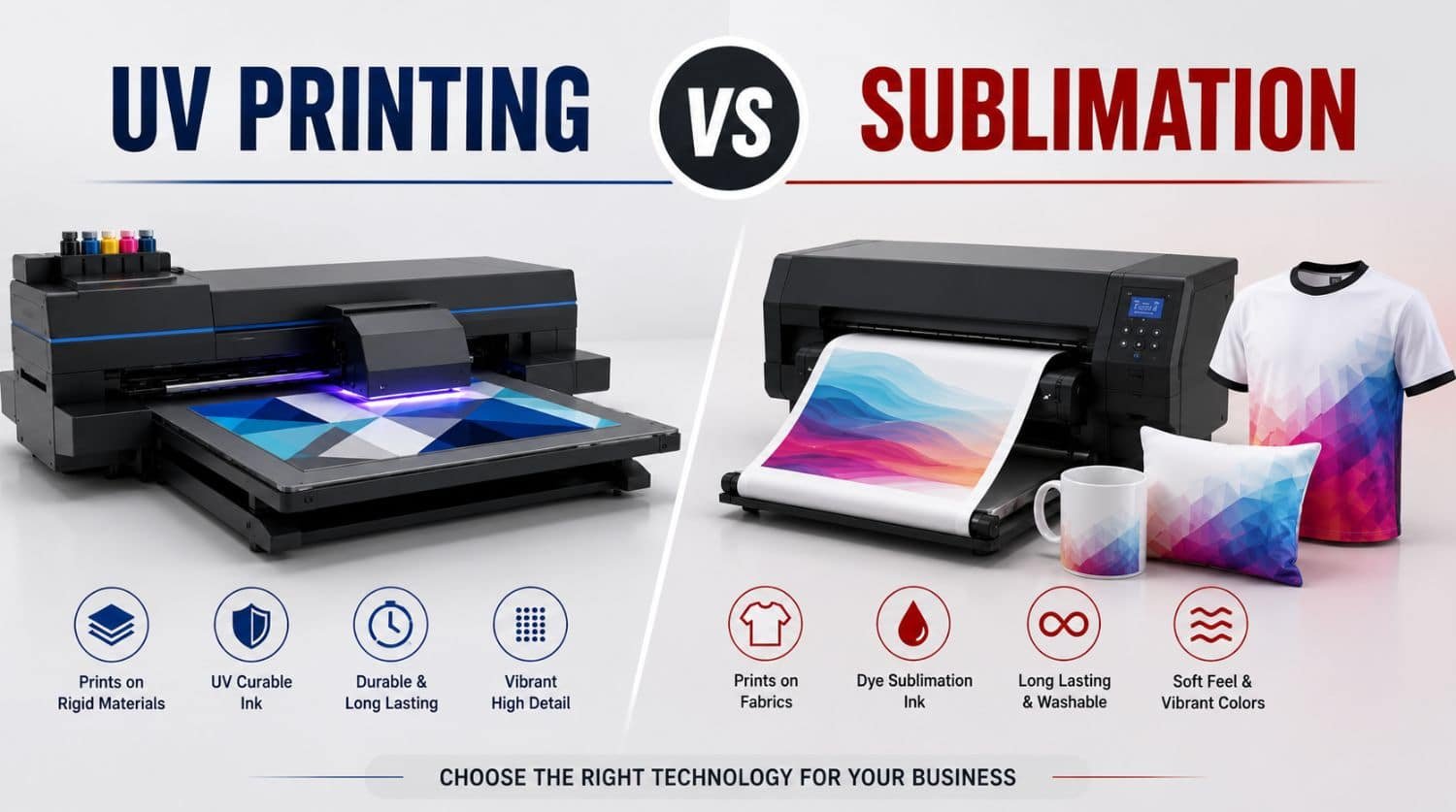
UV printing and sublimation printing are two popular commercial printing technologies, but they serve very different purposes.
UV printing is ideal for rigid materials such as acrylic, glass, wood, metal, PVC, and promotional products.
Sublimation printing is designed primarily for polyester fabrics, mugs, phone cases, and coated promotional products where vibrant, long-lasting colors are required.
If your business focuses on signage, promotional products, and industrial printing, UV printing is typically the better choice. If you specialize in apparel, sportswear, photo gifts, and personalized merchandise, sublimation printing is often the better investment.
Table of Contents
- Introduction
- What Is UV Printing?
- What Is Sublimation Printing?
- How UV Printing Works
- How Sublimation Printing Works
- UV Printing vs Sublimation: Material Compatibility
- UV Printing vs Sublimation: Print Quality
- UV Printing vs Sublimation: Durability
- UV Printing vs Sublimation: Production Speed
- UV Printing vs Sublimation: Startup Costs
- UV Printing vs Sublimation: Business Applications
- Which Technology Is More Profitable?
- UV Printing vs Sublimation Comparison Table
- Which Technology Should You Choose?
- Common Mistakes When Choosing Between UV and Sublimation
- Frequently Asked Questions
- Related Guides
- Final Thoughts
Introduction
When investing in commercial printing equipment, many business owners compare UV printing and sublimation printing because both technologies are widely used for customized products.
At first glance, they may seem similar because both can produce vibrant, professional-quality prints.
However, they operate using completely different processes and are designed for different materials and business models.
Choosing the wrong technology can result in:
- Limited product offerings
- Reduced profitability
- Unnecessary equipment costs
- Production inefficiencies
This guide explains the differences between UV and sublimation printing so you can determine which technology is best suited to your business goals.
For a complete overview of commercial printing technologies, see: Commercial Printing Technologies Explained: Complete Business Guide
What Is UV Printing?
UV printing uses ultraviolet light to instantly cure specially formulated inks during the printing process.
As the printer applies ink to a surface, UV lamps immediately harden the ink.
This allows UV printers to print directly onto a wide range of materials.
Common UV Printing Materials
- Acrylic
- Glass
- Metal
- Wood
- PVC
- Plastic
- Foam board
- Leather
- Promotional products
Because the ink sits on the surface, UV printing works well on rigid and non-porous materials.
What Is Sublimation Printing?
Sublimation printing uses heat and pressure to transfer dye into polyester-based materials.
Instead of sitting on the surface, the dye becomes part of the material itself.
This creates vibrant, durable prints that resist fading, cracking, and peeling.
Common Sublimation Products
- Sportswear
- Polyester apparel
- Mugs
- Phone cases
- Mouse pads
- Keychains
- Photo gifts
- Promotional merchandise
Sublimation is especially popular in the apparel and personalized gift industries.
How UV Printing Works
The UV printing process is relatively straightforward.
Step 1
Artwork is sent to the printer.
Step 2
UV inks are applied directly to the material.
Step 3
UV lamps instantly cure the ink.
Step 4
The finished product is ready immediately.
One major advantage is that no drying time is required.
How Sublimation Printing Works
The sublimation process involves additional steps.
Step 1
The design is printed onto sublimation transfer paper.
Step 2
The transfer paper is placed onto the product.
Step 3
Heat and pressure convert the dye into gas.
Step 4
The dye permanently bonds with the material.
This process creates highly durable prints.
UV Printing vs Sublimation: Material Compatibility
Material compatibility is one of the biggest differences between the two technologies.
UV Printing Materials
UV printing works on:
- Acrylic
- Glass
- Metal
- Wood
- Plastic
- PVC
- Leather
- Promotional products
Sublimation Materials
Sublimation works on:
- Polyester fabrics
- Polyester-coated products
- Sublimation-ready mugs
- Sublimation-coated gifts
Winner: UV Printing
UV printing supports a much wider range of materials.
UV Printing vs Sublimation: Print Quality
Both technologies produce excellent print quality.
UV Printing Quality
UV printing offers:
- Sharp details
- High-resolution graphics
- Rich colors
- Textured effects
- Specialty finishes
It is particularly effective for signage and promotional products.
Sublimation Quality
Sublimation offers:
- Vibrant colors
- Smooth gradients
- Photo-quality output
- Permanent dye integration
It is widely regarded as one of the best technologies for photographic printing.
Winner: Tie
Both technologies deliver exceptional quality within their intended applications.
UV Printing vs Sublimation: Durability
Durability is important for customer satisfaction.
UV Printing Durability
UV prints offer:
- Water resistance
- Scratch resistance
- Outdoor durability
- UV resistance
The durability depends on material type and ink quality.
Sublimation Durability
Sublimation prints offer:
- Fade resistance
- Crack resistance
- Peel resistance
- Wash durability
Because the dye becomes part of the material, sublimation is extremely durable.
Winner: Sublimation
For apparel and coated products, sublimation generally offers superior long-term durability.
UV Printing vs Sublimation: Production Speed
Production speed directly affects profitability.
UV Printing Speed
Advantages include:
- Direct printing
- No transfer paper
- Instant curing
- Immediate product handling
Sublimation Speed
Requires:
- Printing transfer paper
- Product preparation
- Heat pressing
This creates additional production steps.
Winner: UV Printing
UV printing generally offers faster workflows.
UV Printing vs Sublimation: Startup Costs
Investment costs vary significantly.
UV Printing Costs
UV printers are generally more expensive because they include:
- UV curing systems
- Specialized printheads
- Industrial components
Startup costs can be substantial.
Sublimation Costs
Sublimation setups often require:
- Sublimation printer
- Heat press
- Transfer paper
Entry-level systems are relatively affordable.
Winner: Sublimation
Sublimation is usually easier and less expensive for beginners.
UV Printing vs Sublimation: Business Applications
The best technology depends on your target market.
UV Printing Applications
Popular products include:
- Signage
- Acrylic displays
- Awards
- Promotional products
- Packaging prototypes
- Corporate gifts
- Industrial products
Sublimation Applications
Popular products include:
- Sportswear
- Jerseys
- T-shirts
- Mugs
- Photo gifts
- Personalized merchandise
- Promotional products
Which Technology Is More Profitable?
Profitability depends on your niche.
UV Printing Businesses
Often serve:
- Sign companies
- Advertising agencies
- Corporate clients
- Promotional product suppliers
Projects can generate high-value orders.
Sublimation Businesses
Typically focus on:
- Apparel
- Sportswear
- Personalized gifts
- Event merchandise
These markets often provide consistent recurring demand.
The Real Winner
The most profitable technology depends on your target customers rather than the equipment itself.
UV Printing vs Sublimation Comparison Table
| Feature | UV Printing | Sublimation Printing |
| Material Range | Excellent | Limited |
| Polyester Apparel | No | Excellent |
| Acrylic Printing | Excellent | No |
| Glass Printing | Excellent | No |
| Promotional Products | Excellent | Excellent |
| Print Quality | Excellent | Excellent |
| Durability | Very Good | Excellent |
| Startup Cost | Higher | Lower |
| Production Speed | Faster | Slower |
| Signage Production | Excellent | Poor |
| Sportswear Production | Poor | Excellent |
Which Technology Should You Choose?
Choose UV Printing If You Want To Print:
- Acrylic signs
- Glass products
- Metal products
- Wood products
- Promotional products
- Corporate gifts
- Retail displays
Choose Sublimation If You Want To Print:
- Sportswear
- Polyester garments
- Mugs
- Photo gifts
- Personalized merchandise
- Event products
Choose Both If You Operate:
- Large print shops
- Commercial printing businesses
- Promotional product companies
Many successful businesses use both technologies to expand their product range.
Common Mistakes When Choosing Between UV and Sublimation
Assuming They Serve the Same Market
They don’t.
UV and sublimation target very different products.
Ignoring Material Requirements
Sublimation requires polyester or coated surfaces.
Choosing Based Only on Equipment Price
Focus on long-term business opportunities, not just startup costs.
Underestimating Customer Demand
Research local demand before investing.
Frequently Asked Questions
Is UV printing better than sublimation?
Neither is universally better. Each technology is designed for different products and materials.
Can UV printers print on fabric?
Generally, UV printing is not ideal for apparel and fabric applications.
Can sublimation print on cotton?
Not effectively. Sublimation works best on polyester fabrics and coated products.
Which is more profitable, UV printing or sublimation?
Profitability depends on your market, products, and customer demand.
Can one business use both technologies?
Yes. Many commercial printing companies successfully operate both UV and sublimation systems.
Related Guides
- Commercial Printing Technologies Explained: Complete Business Guide (Internal Link)
- Best DTF Printer for Small Business: Top Picks for 2026 (Internal Link)
- DTF vs DTG Printing: Which Is Better for Your Business? (Internal Link)
Final Thoughts
UV printing and sublimation printing are both powerful commercial printing technologies, but they are designed for completely different applications.
If your focus is signage, acrylic products, corporate gifts, and industrial printing, UV printing is usually the best investment.
If your business specializes in sportswear, apparel, mugs, photo gifts, and personalized merchandise, sublimation printing is often the better choice.
The key is understanding your target market, product range, and long-term business goals before investing in equipment.
By selecting the right technology from the start, you can maximize profitability, expand your product offerings, and build a successful printing business in 2026 and beyond.