Commercial Printing Technologies Explained: Complete Business Guide (2026)
What Are Commercial Printing Technologies?
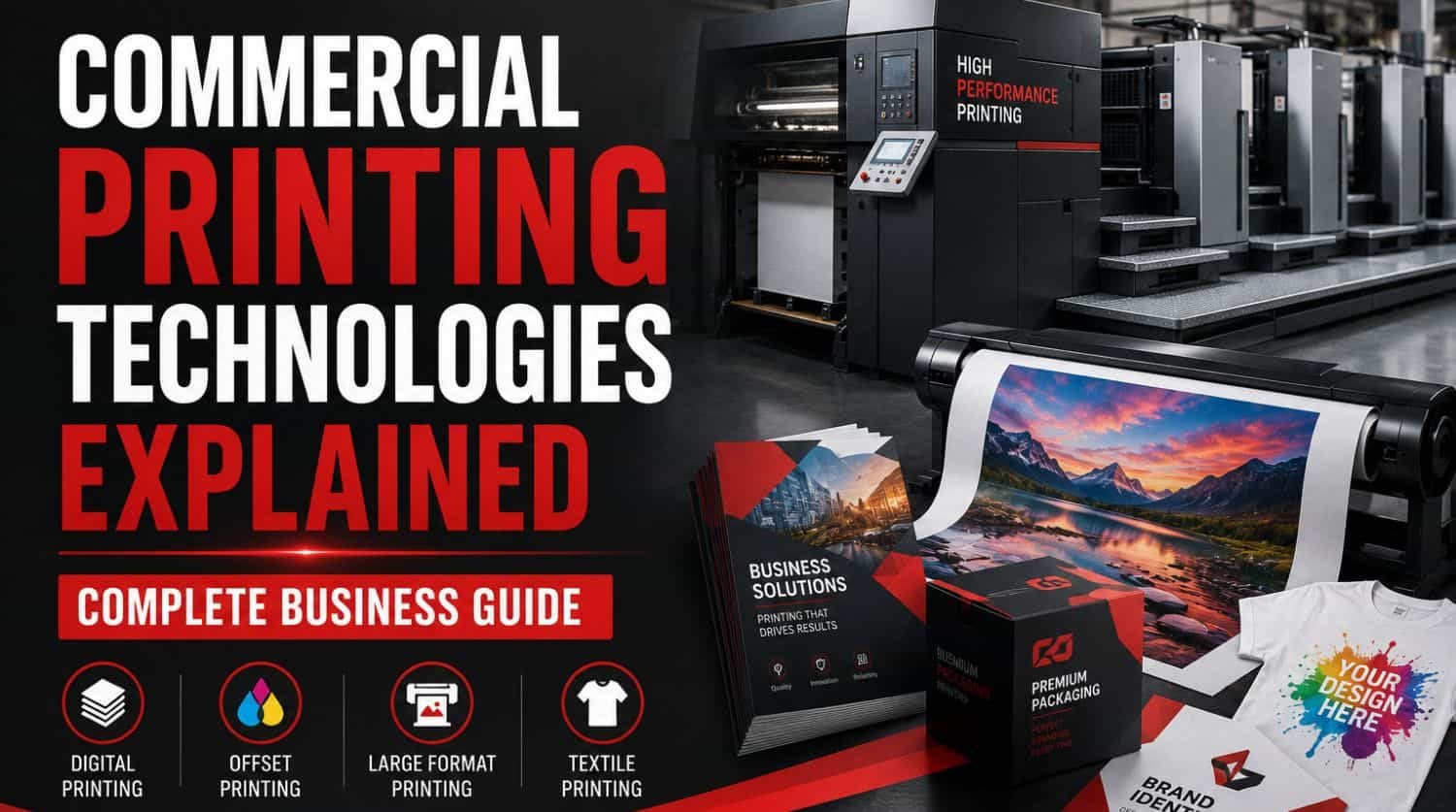
Commercial printing technologies are professional printing methods used by businesses to produce products such as apparel, signage, packaging, marketing materials, labels, promotional products, photographs, and custom merchandise.
The most common commercial printing technologies include:
- DTF Printing (Direct-to-Film)
- DTG Printing (Direct-to-Garment)
- UV Printing
- Sublimation Printing
- Offset Printing
- Digital Printing
- Large Format Printing
- Eco-Solvent Printing
- Latex Printing
Each technology serves different industries, materials, production volumes, and business goals.
Table of Contents
- Introduction
- Why Understanding Printing Technologies Matters
- Major Categories of Commercial Printing Technologies
- DTF Printing (Direct-to-Film)
- DTG Printing (Direct-to-Garment)
- UV Printing
- Sublimation Printing
- UV Printing vs Sublimation
- Offset Printing
- Digital Printing
- Large Format Printing
- Eco-Solvent Printing
- Latex Printing
- Choosing the Right Printing Technology
- Printing Technology Comparison Table
- Frequently Asked Questions
- Related Commercial Printing Guides
- Final Thoughts
Introduction
The printing industry has evolved dramatically over the last decade.
Modern businesses no longer rely on a single printing method. Instead, they choose technologies based on:
- Product type
- Production volume
- Material compatibility
- Print quality requirements
- Startup budget
- Profit margins
Whether you’re starting a custom apparel business, opening a photo studio, launching a signage company, or expanding a commercial print shop, understanding different printing technologies is essential.
The right printing technology can:
- Increase profitability
- Improve production efficiency
- Expand product offerings
- Reduce operating costs
- Create competitive advantages
This guide explains the most important commercial printing technologies used today and helps businesses understand which solutions best fit their needs.
Why Understanding Printing Technologies Matters
Many businesses invest in printing equipment without fully understanding how each technology works.
This often leads to:
- Buying the wrong equipment
- Limited product offerings
- Higher production costs
- Reduced profit margins
- Customer dissatisfaction
Understanding printing methods allows businesses to make smarter investment decisions and choose equipment that aligns with their goals.
Major Categories of Commercial Printing Technologies
Commercial printing technologies generally fall into six major categories:
Textile Printing
Used for:
- T-shirts
- Hoodies
- Sportswear
- Promotional apparel
- Fashion products
Popular technologies include:
- DTF
- DTG
- Sublimation
Signage Printing
Used for:
- Indoor signs
- Outdoor signs
- Vehicle graphics
- Banners
- Retail displays
Popular technologies include:
- UV Printing
- Eco-Solvent Printing
- Latex Printing
Photo Printing
Used for:
- Professional photography
- Event photography
- Studio printing
- Albums
- Photo gifts
Popular technologies include:
- Dye Sublimation
- Inkjet Photo Printing
- Minilab Systems
Commercial Document Printing
Used for:
- Brochures
- Flyers
- Business cards
- Catalogs
- Corporate materials
Popular technologies include:
- Digital Printing
- Offset Printing
Packaging Printing
Used for:
- Product boxes
- Labels
- Flexible packaging
- Brand packaging
Popular technologies include:
- UV Printing
- Offset Printing
- Digital Packaging Printing
Industrial Printing
Used for:
- Promotional products
- Acrylic products
- Wood products
- Metal products
- Glass printing
Popular technologies include:
- UV Flatbed Printing
DTF Printing (Direct-to-Film)
DTF printing has become one of the fastest-growing commercial printing technologies.
Instead of printing directly onto garments, designs are printed onto a special film and transferred to fabric using heat and adhesive powder.
Advantages
- Works on cotton
- Works on polyester
- Vibrant colors
- Excellent durability
- Lower startup costs
- Suitable for small businesses
Limitations
- Film and powder required
- Transfer process involved
- Additional production steps
Best For
- Custom apparel businesses
- Print-on-demand stores
- Startup clothing brands
For equipment recommendations, see: Best DTF Printer for Small Business: Top Picks for 2026
DTG Printing (Direct-to-Garment)
DTG printing applies ink directly onto garments.
This technology is popular for detailed artwork and full-color apparel designs.
Advantages
- High detail printing
- Soft fabric feel
- No transfer film required
- Ideal for complex designs
Limitations
- Slower production
- Higher ink costs
- Best suited to cotton fabrics
Best For
- Premium apparel brands
- Custom t-shirt businesses
- Short-run garment printing
For a detailed comparison, see: DTF vs DTG Printing: Which Is Better for Your Business?
UV Printing
UV printing uses ultraviolet light to instantly cure ink during printing.
This allows printing on a wide range of rigid and non-porous materials.
Compatible Materials
- Acrylic
- Glass
- Wood
- Metal
- Plastic
- PVC
- Promotional products
Advantages
- Instant curing
- Durable prints
- Outdoor resistance
- Premium finish
Best For
- Signage companies
- Promotional product businesses
- Industrial printing
Sublimation Printing
Sublimation printing uses heat to transfer dye directly into polyester materials.
Unlike surface printing, sublimation becomes part of the material itself.
Advantages
- Long-lasting prints
- Vibrant colors
- No cracking or peeling
- Excellent photo quality
Limitations
- Requires polyester materials
- Does not work effectively on dark fabrics
Best For
- Sportswear
- Mugs
- Phone cases
- Photo gifts
- Promotional items
For a complete comparison, see: UV Printing vs Sublimation: Key Differences Explained
UV Printing vs Sublimation
Businesses often compare UV and sublimation because both are used for customized products.
| Feature | UV Printing | Sublimation |
| Works on Rigid Materials | Yes | No |
| Works on Polyester Fabric | No | Yes |
| Outdoor Durability | Excellent | Good |
| Promotional Products | Excellent | Excellent |
| Acrylic Printing | Yes | No |
| Sportswear Printing | No | Excellent |
The right choice depends entirely on your target products.
Offset Printing
Offset printing remains one of the most widely used commercial printing technologies.
Ink is transferred from printing plates onto paper.
Advantages
- Extremely high quality
- Cost-effective for large volumes
- Consistent color reproduction
Best For
- Books
- Magazines
- Packaging
- Corporate printing
Limitations
- Higher setup costs
- Not ideal for short runs
Digital Printing
Digital printing eliminates printing plates and prints directly from digital files.
Advantages
- Fast setup
- Short-run efficiency
- Variable data printing
- Lower startup costs
Best For
- Business cards
- Flyers
- Small-volume projects
Large Format Printing
Large format printing produces oversized graphics and signage.
Common Products
- Banners
- Posters
- Trade show displays
- Wall graphics
- Vehicle wraps
Popular Technologies
- Eco-Solvent
- Latex
- UV Roll-to-Roll
Eco-Solvent Printing
Eco-solvent printers use solvent-based inks suitable for outdoor graphics.
Advantages
- Outdoor durability
- Excellent color reproduction
- Vehicle graphics compatibility
Best For
- Sign shops
- Advertising companies
- Vehicle wrap businesses
Latex Printing
Latex printing uses water-based inks and heat curing technology.
Advantages
- Environmentally friendly
- Low odor
- Indoor and outdoor applications
Best For
- Retail graphics
- Wall coverings
- Commercial signage
Choosing the Right Printing Technology
The best technology depends on your business model.
Apparel Business
Recommended:
- DTF
- DTG
- Sublimation
Signage Company
Recommended:
- UV Printing
- Eco-Solvent
- Latex
Photo Studio
Recommended:
- Dye Sublimation
- Photo Printers
- Minilab Systems
Commercial Print Shop
Recommended:
- Digital Printing
- Offset Printing
Promotional Product Business
Recommended:
- UV Printing
- Sublimation
Printing Technology Comparison Table
| Technology | Startup Cost | Print Quality | Best For |
| DTF | Medium | High | Apparel |
| DTG | High | High | Premium Garments |
| UV | High | Excellent | Signage & Promotional Products |
| Sublimation | Medium | Excellent | Polyester Products |
| Offset | Very High | Excellent | Mass Production |
| Digital | Medium | High | Commercial Printing |
| Eco-Solvent | High | High | Outdoor Signage |
| Latex | High | High | Retail Graphics |
Frequently Asked Questions
Which printing technology is best for beginners?
DTF printing is often considered one of the best options for beginners because of its versatility and relatively low startup costs.
Is DTF better than DTG?
It depends on your business goals, production volume, and target products.
See: DTF vs DTG Printing: Which Is Better for Your Business?
What is the most profitable printing business?
Popular profitable niches include:
- Custom apparel
- Signage printing
- Promotional products
- Photo printing
- Packaging printing
Is UV printing better than sublimation?
Neither is universally better. They serve different applications and materials.
Which printing technology is growing the fastest?
DTF printing is currently one of the fastest-growing commercial printing technologies worldwide.
Related Commercial Printing Guides
- Best DTF Printer for Small Business: Top Picks for 2026
- DTF vs DTG Printing: Which Is Better for Your Business?
- UV Printing vs Sublimation: Key Differences Explained
Final Thoughts
Commercial printing technologies continue to evolve as businesses demand faster production, higher quality, and greater customization.
Whether you’re entering the apparel industry, launching a signage company, expanding a photo studio, or operating a commercial print shop, understanding available printing technologies is essential for long-term success.
By learning the strengths, limitations, and ideal applications of each printing method, you can invest confidently, improve profitability, and choose the technology that best supports your business goals.
Use this guide as your foundation for understanding modern commercial printing technologies and explore the related articles for deeper comparisons and equipment recommendations.