
DTF vs DTG Printing: Which Is Better for Your Business? (2026)
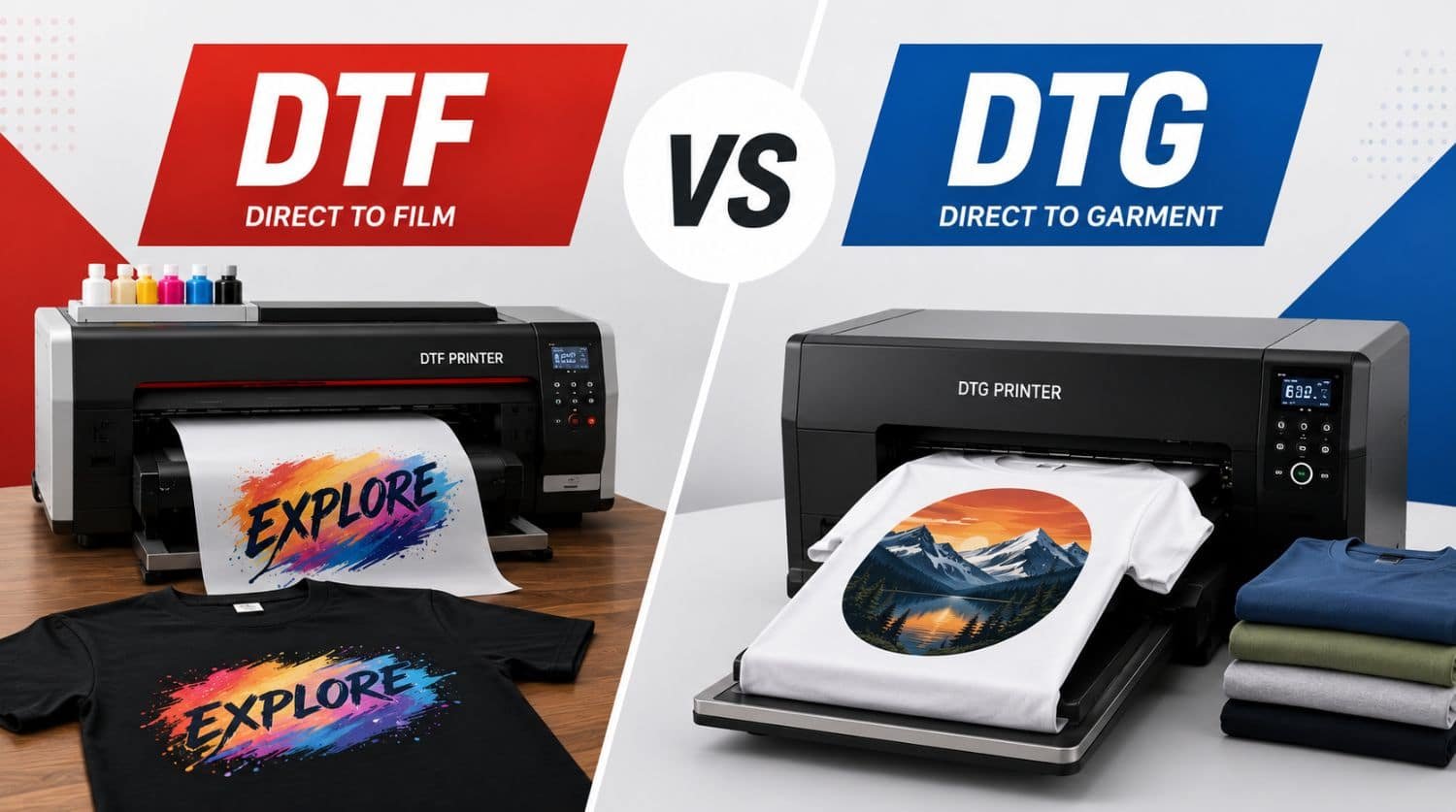
DTF vs DTG Printing
DTF (Direct-to-Film) and DTG (Direct-to-Garment) are two of the most popular apparel printing technologies available today.
DTF printing is generally more versatile because it works on cotton, polyester, blends, and dark garments while requiring a lower startup investment.
DTG printing offers exceptional detail and a softer print feel but works best on cotton garments and often involves higher equipment and maintenance costs.
For most startups and small businesses, DTF printing is typically the more practical choice, while DTG is often preferred by premium apparel brands focused on high-quality cotton garments.
Table of Contents
- Introduction
- What Is DTF Printing?
- What Is DTG Printing?
- DTF vs DTG: Key Differences
- Print Quality Comparison
- Fabric Compatibility Comparison
- Startup Cost Comparison
- Production Speed Comparison
- Durability Comparison
- Maintenance Comparison
- Profitability Comparison
- DTF vs DTG Comparison Table
- Which Technology Is Best for Different Businesses?
- Best DTF Printers for Small Businesses
- Common Myths About DTF and DTG
- Frequently Asked Questions
- Related Guides
- Final Thoughts
Introduction
If you’re starting a custom apparel business, one of the biggest decisions you’ll face is choosing between DTF printing and DTG printing.
Both technologies can produce professional-quality garments, but they work very differently and are designed for different business models.
Choosing the wrong technology can lead to:
- Higher operating costs
- Limited product offerings
- Reduced profit margins
- Production bottlenecks
- Customer dissatisfaction
Before investing thousands of dollars into equipment, it’s important to understand the strengths and limitations of each method.
This guide compares DTF and DTG printing across:
- Print quality
- Fabric compatibility
- Startup costs
- Production speed
- Maintenance
- Profitability
- Scalability
By the end, you’ll know which printing technology is the better fit for your business.
For a broader overview of printing technologies, see: Commercial Printing Technologies Explained: Complete Business Guide
What Is DTF Printing?
DTF stands for Direct-to-Film printing.
The process involves:
- Printing a design onto a special transfer film.
- Applying adhesive powder.
- Curing the film.
- Heat pressing the design onto a garment.
Unlike many apparel printing methods, DTF works on a wide variety of materials.
Compatible Materials
- Cotton
- Polyester
- Blended fabrics
- Canvas
- Denim
- Sportswear
This versatility has made DTF one of the fastest-growing apparel printing technologies worldwide.
What Is DTG Printing?
DTG stands for Direct-to-Garment printing.
Instead of using transfer film, the printer applies ink directly onto the garment.
The process is similar to printing on paper but uses specialized textile inks.
Compatible Materials
DTG works best on:
- 100% cotton
- Cotton-rich garments
While DTG can work on some blends, cotton generally produces the best results.
DTF vs DTG: Key Differences
Let’s compare both technologies across the factors that matter most to business owners.
Print Quality Comparison
Print quality is often the first consideration.
DTF Printing Quality
DTF offers:
- Vibrant colors
- Strong color saturation
- Excellent durability
- Good detail reproduction
Modern DTF printers can produce highly professional results suitable for commercial apparel businesses.
DTG Printing Quality
DTG excels at:
- Fine details
- Complex artwork
- Photographic images
- Smooth gradients
Many premium apparel brands prefer DTG for intricate designs.
Winner: DTG
For maximum detail and premium artwork reproduction, DTG generally has a slight advantage.
However, the difference is becoming smaller as DTF technology improves.
Fabric Compatibility Comparison
This category is one of the biggest reasons many businesses choose DTF.
DTF Fabric Compatibility
DTF works on:
- Cotton
- Polyester
- Blends
- Dark fabrics
- Light fabrics
One printer can handle a wide range of products.
DTG Fabric Compatibility
DTG performs best on:
- Cotton garments
Polyester and synthetic fabrics often present challenges.
Winner: DTF
DTF offers significantly greater material flexibility.
Startup Cost Comparison
Budget is often a major factor for new businesses.
DTF Startup Costs
A typical DTF setup includes:
- DTF printer
- Heat press
- Transfer film
- Powder adhesive
Entry-level systems are available at relatively affordable prices.
DTG Startup Costs
A DTG setup generally requires:
- DTG printer
- Pretreatment equipment
- Heat press
- Maintenance supplies
The initial investment is usually much higher.
Winner: DTF
DTF is generally more affordable for startups and small businesses.
Production Speed Comparison
Production efficiency directly impacts profitability.
DTF Production Workflow
DTF allows:
- Batch production
- Transfer storage
- Multiple garment applications
Designs can be printed in advance and applied when needed.
DTG Production Workflow
DTG often requires:
- Pretreatment
- Direct garment setup
- Individual printing
This can slow production for larger order volumes.
Winner: DTF
For most commercial production environments, DTF offers better efficiency.
Durability Comparison
Customers expect garments to withstand repeated washing.
DTF Durability
Properly produced DTF transfers offer:
- Excellent wash resistance
- Strong adhesion
- Long-lasting colors
DTG Durability
DTG prints can also provide excellent durability when printed correctly.
However, results depend heavily on pretreatment and garment quality.
Winner: Tie
Both technologies can deliver durable products when used properly.
Maintenance Comparison
Maintenance affects both downtime and operating costs.
DTF Maintenance
Common tasks include:
- Printhead cleaning
- Ink circulation management
- Film handling maintenance
Maintenance requirements are generally moderate.
DTG Maintenance
DTG systems often require:
- Frequent cleaning
- White ink maintenance
- Pretreatment management
Maintenance is usually more intensive.
Winner: DTF
Most small businesses find DTF easier to manage.
Profitability Comparison
Profitability depends on:
- Equipment costs
- Production speed
- Material costs
- Labor requirements
Why Many Businesses Choose DTF
DTF often offers:
- Lower startup costs
- Faster production
- Broader product range
- Greater flexibility
These factors can improve profit margins.
Why Some Businesses Choose DTG
DTG may be preferred for:
- Premium apparel brands
- High-end custom garments
- Detailed artwork
Businesses focused on premium cotton apparel may justify the additional investment.
Winner: DTF
For most small and medium-sized businesses, DTF offers a better balance of cost and profitability.
DTF vs DTG Comparison Table
| Feature | DTF Printing | DTG Printing |
| Startup Cost | Lower | Higher |
| Print Quality | Excellent | Excellent |
| Detail Reproduction | Very Good | Outstanding |
| Cotton Printing | Excellent | Excellent |
| Polyester Printing | Excellent | Limited |
| Dark Garments | Excellent | Excellent |
| Production Speed | Faster | Slower |
| Maintenance | Moderate | Higher |
| Scalability | Excellent | Good |
| Small Business Friendly | Excellent | Good |
Which Technology Is Best for Different Businesses?
Home-Based Apparel Startup
Recommended:
- DTF Printing
Reasons:
- Lower investment
- Easier operation
- Greater flexibility
Custom T-Shirt Business
Recommended:
- DTF Printing
Reasons:
- Works on multiple garment types
- Faster production
Premium Fashion Brand
Recommended:
- DTG Printing
Reasons:
- Exceptional detail
- Premium garment feel
High-Volume Print Shop
Recommended:
- DTF Printing
Reasons:
- Better production efficiency
- Higher scalability
Best DTF Printers for Small Businesses
If you’re leaning toward DTF, choosing the right equipment is essential.
See: Best DTF Printer for Small Business: Top Picks for 2026
for a detailed breakdown of popular DTF printers and buying recommendations.
Common Myths About DTF and DTG
Myth: DTG Always Produces Better Prints
Not necessarily.
Modern DTF systems can produce professional-quality garments that satisfy most commercial customers.
Myth: DTF Feels Cheap
High-quality DTF transfers can feel soft, durable, and premium when applied correctly.
Myth: DTG Works on Every Fabric
DTG performs best on cotton and may not deliver the same results on polyester or synthetic materials.
Myth: DTF Is Only for Beginners
Many large-scale apparel businesses use industrial DTF systems successfully.
Frequently Asked Questions
Is DTF better than DTG?
For most startups and growing apparel businesses, DTF is often the better choice because of its lower cost and greater flexibility.
Which is more profitable, DTF or DTG?
DTF is generally more profitable for small businesses due to lower startup costs and broader material compatibility.
Does DTF last as long as DTG?
Yes. When produced correctly, DTF prints can provide excellent durability and wash resistance.
Can DTF print on polyester?
Yes. DTF works very well on polyester fabrics.
Is DTG still worth it in 2026?
Yes. DTG remains an excellent option for premium cotton apparel and detailed artwork.
Related Guides
- Commercial Printing Technologies Explained: Complete Business Guide (Internal Link)
- Best DTF Printer for Small Business: Top Picks for 2026 (Internal Link)
Final Thoughts
Both DTF and DTG printing are powerful technologies capable of producing professional-quality apparel.
However, the best choice depends on your business goals.
If you want maximum flexibility, lower startup costs, broader fabric compatibility, and strong profitability, DTF printing is usually the better investment.
If your focus is premium cotton garments, high-detail artwork, and fashion-oriented products, DTG printing may be worth the additional investment.
For most small businesses entering the apparel printing industry in 2026, DTF remains the more versatile and business-friendly solution, making it one of the fastest-growing printing technologies worldwide.