Best Barcode Printer for Warehouse Operations (2026)
What Is the Best Barcode Printer for Warehouses?
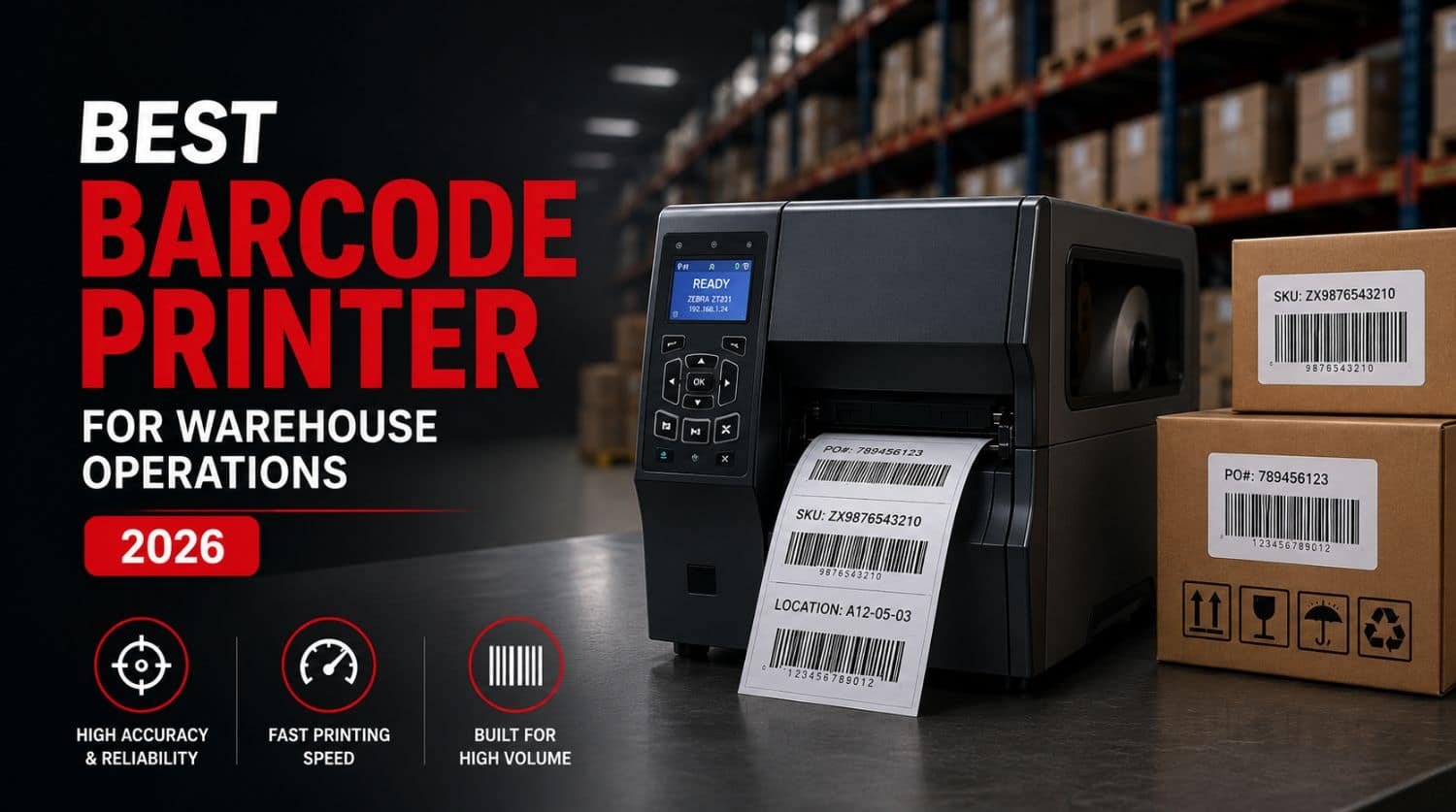
The best barcode printer for warehouse operations depends on your daily print volume, durability requirements, and integration needs.
Some of the most popular warehouse barcode printers include:
- Zebra ZT411
- Zebra ZT231
- Zebra ZT610
- Honeywell PM45
- TSC MB240
- TSC MH241
For most medium to large warehouses, industrial barcode printers from Zebra and Honeywell provide the best combination of durability, speed, reliability, and long-term performance.
Table of Contents
- Introduction
- Why Warehouses Need Industrial Barcode Printers
- Common Warehouse Barcode Applications
- What to Look for in a Warehouse Barcode Printer
- Direct Thermal vs Thermal Transfer for Warehouses
- Best Barcode Printers for Warehouse Operations
- Zebra vs Honeywell for Warehouse Operations
- Best Barcode Printer by Warehouse Size
- Common Warehouse Barcode Printing Challenges
- How Barcode Printers Improve Warehouse Efficiency
- Frequently Asked Questions
- Related Guides
- Final Thoughts
Introduction
Warehouses depend heavily on barcode technology to maintain inventory accuracy, improve productivity, and streamline logistics operations.
Every day, warehouse teams use barcode labels for:
- Inventory tracking
- Product identification
- Shelf labeling
- Shipping labels
- Pallet tracking
- Asset management
- Order fulfillment
A reliable barcode printer helps businesses:
- Reduce inventory errors
- Improve warehouse efficiency
- Speed up operations
- Minimize manual data entry
- Improve customer satisfaction
However, warehouse environments place much greater demands on printers than offices or retail stores.
This guide explains the best barcode printers for warehouse operations and helps businesses choose the right solution for their needs.
For a complete overview of label and barcode printing technology, see: Label and Barcode Printers: Complete Buying Guide for Businesses
Why Warehouses Need Industrial Barcode Printers
Warehouse operations often involve thousands of labels every day.
Standard desktop printers may struggle to handle:
- Continuous printing
- Dusty environments
- Heavy workloads
- Long operating hours
Industrial barcode printers are designed specifically for these conditions.
Benefits include:
Higher Print Volumes
Industrial printers can operate continuously throughout the workday.
Better Durability
Built with stronger materials and industrial-grade components.
Faster Printing
Higher print speeds improve productivity.
Better Barcode Accuracy
Clear, scannable labels reduce warehouse errors.
Common Warehouse Barcode Applications
Warehouses use barcode printers in multiple areas.
Inventory Labels
Used for:
- Product identification
- Stock tracking
- Bin management
Accurate inventory labels improve warehouse visibility.
Shelf Labels
Help workers quickly locate products.
Common in:
- Distribution centers
- Fulfillment warehouses
- Manufacturing facilities
Shipping Labels
Essential for:
- Order fulfillment
- Logistics operations
- Carrier compliance
Pallet Labels
Used to track:
- Bulk inventory
- Warehouse movement
- Distribution processes
Asset Tracking Labels
Used for:
- Equipment management
- Tool tracking
- Warehouse assets
What to Look for in a Warehouse Barcode Printer
Before investing, evaluate several important factors.
Print Volume
How many labels are printed daily?
Small Warehouse
Up to 500 labels per day.
Medium Warehouse
500–5,000 labels per day.
Large Warehouse
5,000+ labels daily.
Higher volume operations require industrial-grade equipment.
Print Speed
Warehouse productivity depends on efficient label generation.
Industrial printers commonly support:
- 8 inches per second
- 10 inches per second
- 14 inches per second
Faster printing reduces bottlenecks.
Durability
Warehouse conditions can be demanding.
Look for printers designed to handle:
- Dust
- Continuous operation
- Temperature variations
- Heavy workloads
Connectivity Options
Modern warehouse printers should support:
- USB
- Ethernet
- Wi-Fi
- Bluetooth
Network connectivity simplifies deployment.
Barcode Compatibility
Ensure support for:
1D Barcodes
- Code 128
- Code 39
- UPC
- EAN
2D Barcodes
- QR Codes
- Data Matrix
Many warehouses increasingly rely on QR-based systems.
Direct Thermal vs Thermal Transfer for Warehouses
Most warehouse printers use one of two technologies.
Direct Thermal Printing
Advantages:
- No ribbon required
- Lower operating costs
- Simpler operation
Best for:
- Shipping labels
- Temporary labels
Limitations:
- Labels can fade over time
Thermal Transfer Printing
Advantages:
- Long-lasting labels
- Greater durability
- Better resistance to wear
Best for:
- Inventory tracking
- Asset management
- Long-term storage
Most warehouses prefer thermal transfer printers.
Best Barcode Printers for Warehouse Operations
Below are some of the most reliable barcode printers used in warehouses worldwide.
1. Zebra ZT411
The Zebra ZT411 is one of the most popular industrial barcode printers available.
Advantages
- Excellent reliability
- Fast printing speeds
- Strong enterprise support
- Durable construction
Best For
- Medium warehouses
- Distribution centers
- Manufacturing operations
Limitations
- Higher initial investment
2. Zebra ZT231
The ZT231 offers industrial performance at a more accessible price point.
Advantages
- Cost-effective
- User-friendly interface
- Reliable operation
Best For
- Growing warehouse operations
Limitations
- Fewer advanced options than premium models
3. Zebra ZT610
The ZT610 is designed for demanding industrial environments.
Advantages
- Exceptional durability
- High-resolution printing
- Heavy-duty performance
Best For
- Large-scale warehouses
- High-volume operations
Limitations
- Premium pricing
4. Honeywell PM45
The Honeywell PM45 is widely used in logistics and supply chain environments.
Advantages
- Enterprise-grade reliability
- Excellent barcode quality
- Strong integration options
Best For
- Logistics companies
- Large warehouses
Limitations
- Higher complexity for smaller operations
5. TSC MB240
The MB240 provides strong performance at a competitive price.
Advantages
- Reliable operation
- Good print quality
- Affordable ownership costs
Best For
- Small and medium warehouses
Limitations
- Smaller ecosystem than Zebra
6. TSC MH241
The MH241 is designed for high-volume industrial applications.
Advantages
- Heavy-duty design
- Fast printing
- High-volume capability
Best For
- Industrial facilities
- Manufacturing warehouses
Limitations
- Larger footprint
Zebra vs Honeywell for Warehouse Operations
Many warehouse managers compare Zebra and Honeywell before investing.
| Feature | Zebra | Honeywell |
| Warehouse Reliability | Excellent | Excellent |
| Software Ecosystem | Excellent | Excellent |
| Barcode Quality | Excellent | Excellent |
| Enterprise Deployment | Excellent | Excellent |
| Ease of Use | Excellent | Good |
| Global Support | Excellent | Excellent |
Both brands are excellent choices for warehouse environments.
Best Barcode Printer by Warehouse Size
Small Warehouse
Recommended:
- Zebra ZT231
- TSC MB240
Medium Warehouse
Recommended:
- Zebra ZT411
- Honeywell PM45
Large Warehouse
Recommended:
- Zebra ZT610
- TSC MH241
Enterprise Distribution Centers
Recommended:
- Zebra ZT610
- Honeywell PM45
Common Warehouse Barcode Printing Challenges
Warehouse managers frequently face several challenges.
Poor Barcode Readability
Low-quality labels can slow operations.
Printer Downtime
Unreliable equipment reduces productivity.
Incorrect Label Sizes
Can create scanning issues.
Network Connectivity Problems
Can delay warehouse workflows.
Choosing the right printer helps minimize these issues.
How Barcode Printers Improve Warehouse Efficiency
A reliable barcode system can:
- Reduce picking errors
- Improve inventory accuracy
- Accelerate receiving processes
- Simplify audits
- Improve shipping accuracy
Many warehouses report significant productivity improvements after upgrading their barcode infrastructure.
Frequently Asked Questions
What is the best barcode printer for a warehouse?
The Zebra ZT411 is one of the most widely recommended warehouse barcode printers because of its reliability and performance.
Should warehouses use direct thermal or thermal transfer printers?
Thermal transfer printers are generally preferred because they produce more durable labels.
Are Zebra printers good for warehouses?
Yes. Zebra printers are considered industry leaders in warehouse barcode printing.
For setup instructions, see: Zebra Printer Setup Guide: Installation & Configuration
What barcode printer is best for inventory labels?
Industrial thermal transfer printers are ideal for inventory management.
How long do warehouse barcode labels last?
Thermal transfer labels can remain readable for years when properly produced.
Related Guides
- Label and Barcode Printers: Complete Buying Guide for Businesses
- Best Label Printer for Small Business in 2026
- Zebra Printer Setup Guide: Installation & Configuration
Final Thoughts
A dependable barcode printer is one of the most important investments for any warehouse operation.
From inventory tracking and shipping labels to pallet identification and asset management, barcode printers play a crucial role in maintaining operational efficiency.
For most warehouses, industrial barcode printers from Zebra, Honeywell, and TSC offer the reliability, speed, and durability needed to support daily operations.
By selecting a printer that matches your volume requirements, warehouse size, and future growth plans, you can improve productivity, reduce errors, and create a more efficient warehouse environment.