How to Choose a Large Format Printer for Architectural Plans?
To make accurate architectural drawings and prints, you need to print these documents with a high level of quality. The quality of the print depends on the printer you choose. Most of the time, a large format printer for architectural plans can print very high-quality images that show all the details, sizes, and other information accurately on paper. This lets architects, engineers, and designers make large-scale prints. A good, reliable large format printer will save an architect or project developer time, make fewer mistakes, and make their work look more professional. Also, because technology is always changing, most large format printers are now faster and more accurate than ever before. They can also work with more types of media.
Before you choose a printer, you need to know exactly what your architectural workflow needs. Once you know what your design workflow needs, it will be easier to find a printer that meets those needs and fits your budget.
Why You Need a Large Format Printer for Architectural Plans?
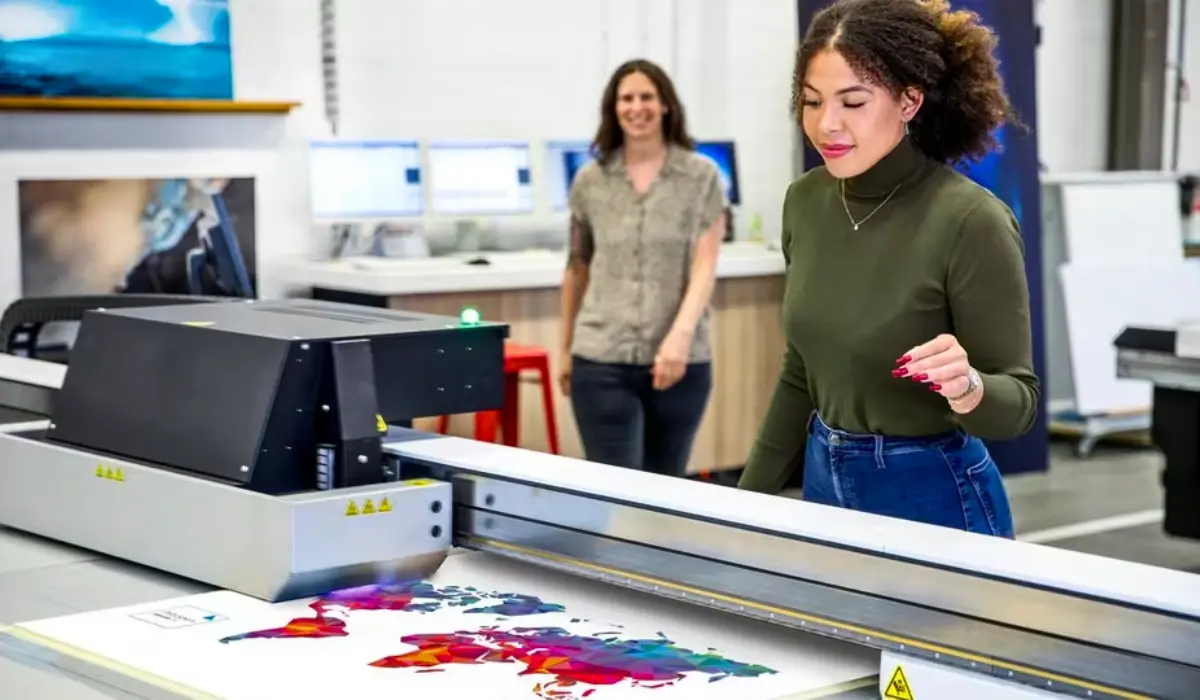
Architectural plans are usually printed on larger paper sizes than the normal A4 and A3 size sheets. Large format printers can print on A1, A0, and other custom-sized paper sheets. The use of these printers permits the production of full-scale architectural drawings without losing the quality of the detail found within them. When a printer is capable of printing in high resolution, it allows the user to read the plans without having to strain to see small markings, intricate detailing, or extensive notations.
By utilizing a reliable printer, the chances of smearing, misaligning, or losing any of the intricate detailing in an architectural plan are reduced. These types of printers work well for businesses that have a high volume of printouts due to the need for multiple sets of architectural plans, printed for clients, contractors, and team members involved in the design and construction of projects.
Key Features to Consider
Print Resolution and Accuracy
Print quality is a major consideration for many architects who use architectural plans as part of their work. To achieve this, a clear and sharp image is essential, along with accurate measurements. A printer that is able to print at least 1200DPI would be ideal for these types of drawings since it will capture all of the fine details and instructions included in your drawing. The accuracy of the printed image is especially important when printing working drawings, mechanical layouts, and electrical plans, because small errors made while printing will lead to significant mistakes when constructing based on the drawing.
Paper Handling and Size Compatibility
The types and sizes of paper that large-format printers can support vary wildly. Depending on what you’re using the printer for, you may want to find a printer that can handle the sizes you typically need for your projects (like A1 or A0) as well as those offered as continuous-roll.
Additionally, the ability to use different media types (like bond paper, coated paper, and even translucent overlays) increases the variety of projects that can be produced using that type of printer. In addition, many models of large-format printers provide features such as automatic paper-feeding and alignment that can greatly reduce the chance of jams and wrong-sized prints.
Speed and Efficiency
The speed of printing large plans is an important consideration because it may be very time-consuming. Therefore, look for printers that can produce high-quality prints quickly without sacrificing fine detail. To save time in high-volume printing environments, consider printers that are equipped with multiple ink cartridges, allowing for faster drying, and that provide the option for double-sided printing. The printer’s ability to produce prints quickly, as well as the printer’s ability to produce prints with consistency, are two aspects of the printer’s efficiency. A printer’s ability to produce prints with consistent quality will allow the user to maintain the clarity and accuracy of each copy of a plan.
Connectivity and Software Integration
Most modern architectural workflows use a combination of CAD (computer-aided design) software and digital design files. It’s important to ensure that your large-format printer is compatible with the design applications commonly used in the architectural industry, such as AutoCAD, Revit, and ArchiCAD. Therefore, if your printer provides the convenience of connecting via USB, Ethernet, or Wi-Fi, it will allow you the flexibility to connect your printer to each of these devices. Furthermore, many printers come with special drivers or print management software that optimally prepare the printing of architectural plans so that the colors, line weights, and scales are accurately represented.
Maintenance and Operating Costs
In addition to the cost of the printer when it is purchased, there are other ongoing expenses. The user should also consider the cost of acquiring replacement inks, toner, or print heads, as well as the availability of these items. Additionally, some printers require that a trained technician provide maintenance, while others are designed for easy self-maintenance.
Top Considerations for Architectural Firms
Volume Needs: Determine the number of printed pieces you will produce each day or week. Firms that operate at high volumes will require heavy-duty printers that can handle continuous printing.
Budget vs Feature: While it is important to stay within a budget, you will need to look at the features you require in order to get a printer that fits your needs. A slightly more expensive printer might provide the best return on investment through efficiency and limited maintenance.
Space & Placement: Large format printers are typically large. Make sure you have adequate space in your office/studio for a printer. Some smaller format printers are compact models but still provide the same high quality as larger models.
Benefits of Using a Dedicated Large Format Printer
Utilizing a large format printer for architectural plans specialized for architectural documentation has many benefits, including fast turnaround times, enhanced reliability with consistent color quality on every print, elimination of the need to use an outside printing supplier, and increased speed when working on drafts, revisions, or finalization of various documents.
Also, printing in-house protects confidentiality for sensitive files and intellectual property related to the project being worked on. A properly configured printer delivers greater collaboration opportunities between design teams by allowing them to assess and modify their plans simultaneously, as they are being printed.
Conclusion
Choosing the best large format printer for your architectural plans can cost a lot of money, but it lets you get the most accurate details and the quickest delivery of those details for your next big commercial or residential project. When choosing a printer, make sure to think about the print resolution, the number of sheets it can handle, the print speed, the ability to connect to a network, and the cost of running it so that it meets your professional needs today.
A good printer makes your work easier, improves the quality of your presentations, and meets the demands of modern architectural practice. So, buying the right printer will improve the quality of your work, make customers happier, and make your business run more smoothly. A dedicated large format printer is a valuable tool in your workplace.