Best Large Format Printer For Graphic Design Studios: Professional Solutions
For graphic design studios that thrive by producing quality visuals. Finding a large-format printer can be a big challenge because there are so many different options available. These types of printers need to be able to deliver high-quality prints from artworks in every format, including prints from branding projects and posters to large-format items such as exhibition graphics and fine art reproductions. Choosing the right large format printer for graphic design studios is not just about size; it’s also about producing prints that are precise, consistent, and reliable throughout daily workflows.
As designers, they expect to reproduce sharp detail, smooth gradients, and accurately reproduce colors as well as printing on a variety of media types. They are also operating under increasingly shorter delivery times and a wider array of client demands, which require their large format printer to also provide efficiency during production while producing premium quality work. This article reviews the ideal large-format printer for a graphic design studio by reviewing key features to look for when selecting a large-format printer and examining one or two of the leading manufacturers’ large-format printers that meet many of the requirements for a modern design studio.
Why do graphic design studios need large-format printing?
Graphic design companies often do work that needs much bigger output than what regular office printers can handle, such as marketing materials, retail signs, wall murals, architectural renderings, and copies of fine art. Graphic designers can now show their designs in full size instead of shrinking them down to standard sizes. This makes their work look more professional and gives them more control over the color, texture, and finish of their finished products.
This is especially important when working on high-quality projects for picky clients. When you make large-format prints in-house, you don’t have to rely on outside suppliers as much, the turnaround time is faster, and the quality is always the same across all projects. This level of control is even more important if you need to make changes quickly or if the colors have to match the brand guidelines exactly.
Key features to look for in a large-format printer
When selecting a printer for a design studio, consider the following features:
- Resolution and color accuracy: Ensures precise tones and smooth transitions for professional-quality prints.
- Ink type: Pigment-based inks offer longevity and resistance to fading.
- Media handling flexibility: Ability to print on paper, canvas, vinyl, and specialty materials.
- Print speed and efficiency: Supports high-volume workflows without compromising quality.
- Connectivity and software integration: Compatible with design tools and easy to manage across workstations.
- Maintenance and support: Reliable technical support and easy upkeep to minimize downtime.
Canon printers for professional graphic design studios
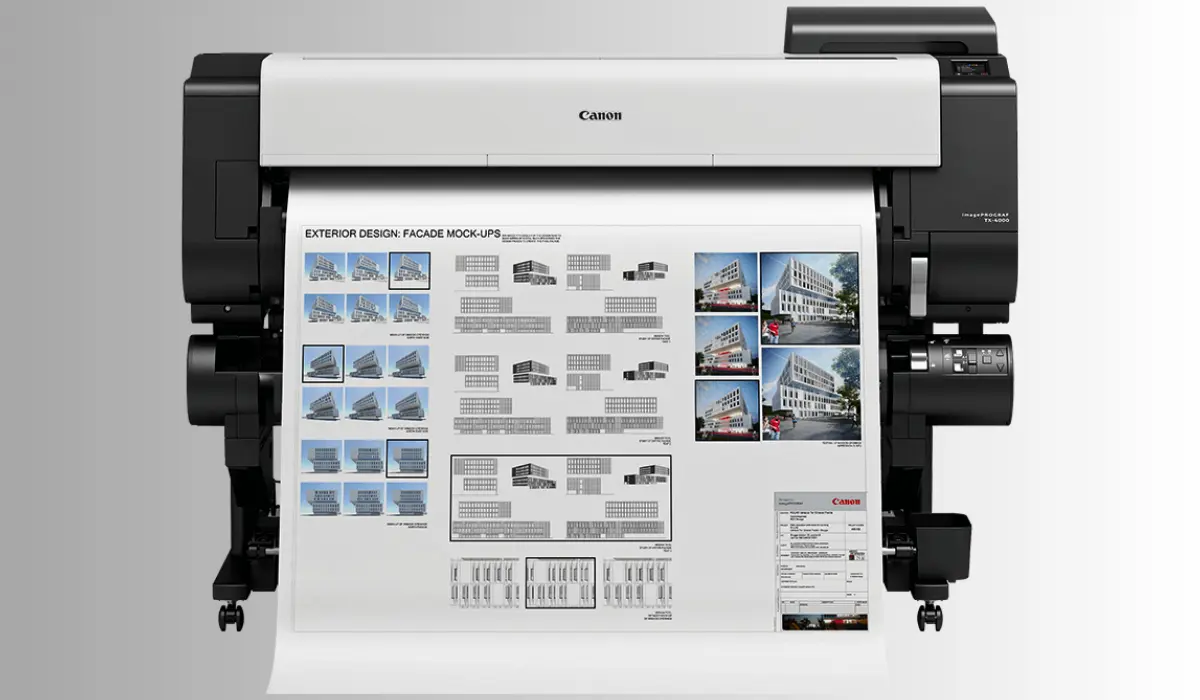
For a long time, Canon’s large-format digital printing equipment has been recognized and admired in the design industry due to its speedy production times, accurate print results, and excellent image quality. The Canon imagePROGRAF printers are designed specifically for the purpose of providing consistently accurate color reproduction, making them ideal candidates for creating or printing also for create posters, brand visual identity graphics, and large format images. These printers are generally equipped with several very advanced ink systems that produce vibrant reds, blues, and very rich and deep blacks that offer the ultimate in print productivity in creating striking graphic designs using a variety of media.
Canon printers are also very compatible with the majority of design software, thus supporting the design studio’s ability to produce the exact colors they see on the computer monitor at the point of printing. With the various features, and their high-quality, heavy-duty construction and dependable operation, Canon printers continue to be one of the most appealing options for design studios that produce multiple copies of printed material every week while still requiring extremely high-quality output.
Epson printers and their advantages for creative workflows
Graphic designers and photographers often choose Epson printers because of their outstanding color depth and detail. In the SureColor series, Epson emphasizes accurate colors and smooth gradients in colour. Colour accuracy and smooth gradient transitions are also key elements required for Artwork, Illustrations, and Photographic reproductions. Epson has advanced ink technologies which provide a very wide range of colours, allowing designers to reproduce faint and/or complex colours and images with assurance.
Many of the Epson models also incorporate energy-saving features and/or low-cost-of-ownership features, which will provide a benefit to the studio managing long-term operational costs. All of this, coupled with a dependable performance and robust colour management tools, allows Epson printers to be used in the creative process in the creation of items that demand high-quality, precise products.
Comparing Canon and Epson for studio needs
In terms of available options, both Canon and Epson make great choices; the best choice for your studio often depends on its area of emphasis. For studios involved in high-volume production environments where high levels of consistency and efficiency are required, Canon tends to be the manufacturer of choice. On the other hand, Epson is more typically considered to be the best choice for projects where maximum color depth and photographic quality are desired.
A studio offering a variety of products (commercial graphics, signage, and fine art) should carefully evaluate the differences between the two brands regarding media types, ink longevity, and color management. Identifying the unique characteristics of both Canon and Epson printers will assist the studio in making the investment in a printer that will enhance the creative vision of those producing artwork for clients.
Benefits of using an in-house large-format printer
Investing in a printer within your studio offers several advantages:
- Creative flexibility: Experiment with layouts, colors, and materials without relying on external vendors.
- Faster project completion: Reduce turnaround times for client projects.
- Consistent quality: Maintain control over color, details, and finish across multiple prints.
- Cost efficiency: Save on long-term outsourcing expenses.
- Confidentiality: Keep sensitive or proprietary designs in-house.
- Operational control: Adjust workflows quickly to meet client needs and deadlines.
Tips for maximizing print quality and longevity
To get the best results from large-format printing, consider the following practices:
- Color management: Calibrate monitors and printers for accurate color reproduction.
- High-quality media: Use premium paper, canvas, or specialty substrates.
- Routine maintenance: Clean and maintain printers regularly to prevent downtime.
- Genuine consumables: Use official inks and components to ensure consistency.
- Staff training: Educate team members on optimal printing techniques.
- Environment control: Keep printing areas at stable temperature and humidity levels to prevent ink issues.
Conclusion
Selecting appropriate printing technology for creation based on strategy will allow you to provide your designers with tools to express their imagination through visual images with assurance and precision. Evaluating key features of large format printer for graphic design studios from recognized companies such as Canon and Epson will enable design professionals to increase both their level of creativity and the level of productivity as well, in accordance with the capabilities of printers provided to each studio.
Large-format print output enhances your studio’s ability to better manage its printing output while improving the end quality of your output, so your studio will be positioned to compete in today’s marketplace. With an appropriate printer established for operation by your graphic design studios, your studios can produce bold and professional images consistently to satisfy your clients, while developing and extending their creative purposes into the future.